 Back and Next - Back and Next
CONGO: Obstacles to easing plight of Baka people
Friday, May 9, 2008
Faced
with the still pressing marginalisation of the indigenous Baka people,
NGOs in Congo are implementing projects to improve living conditions in
these communities.
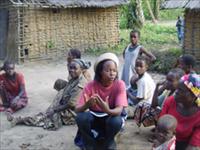
In most of the country, the Baka people, sometimes referred to as Pygmies, have been the victims of poverty, endemic famine, lack of education and basic medical care, social isolation and exclusion from the political decision-making process.
Access to drinking water and a healthy and balanced diet remains a problem and a source of numerous illnesses. In a bid to resolve this situation, NGOs have been trying to implement projects aimed at improving their living conditions. However, they reckon the task is not easy.
For Charles Ngoussa, president of the Dynamisation of Local Initiatives (Dynamic 3), an NGO based in Sibiti, capital of Lékoumou district, all actions aimed at improving the living conditions of the Baka communities should, necessarily, be accompanied by their empowerment to achieve real change.
“When we launched the sewing apprenticeship workshop for young girls, we included four [Baka] girls; but after one semester, only one of them was left,” Ngoussa said. “However, they would have emerged with a vocational skill which might have helped them - if only in the short term - to take charge.”
Paul Madoungou, a Baka and member of the Association for the Integration of Pygmies (ACIP), explained: “When we start a lucrative activity like the cultivation of manioc [cassava], we do not do it well, or we do not make the extra effort to achieve good results because we are obliged to go and work for the Bantus to make sure we have something to eat.”
A day of hard labour in a field belonging to a Bantu can bring in 500-1,000 CFA francs (US$1.20-2.40) in addition to a meagre food allowance.
The Baka are a nomadic people, mostly hunting or fishing. However, in some areas they are switching to agriculture.
For Nina Cynthia Kiyindou, a lawyer working on a project with the Congolese Observatory for Human Rights (OCDH), all projects should be devised and implemented in agreement with the people themselves to ensure success.
“It is important to listen to them to evaluate their problems, and the solutions they think will be best, as well as the way they think is effective in which to implement these solutions,” Kiyindou said.
“The solution to the problems of Baka peoples is not to regularly give them gifts but to help them to take control, be self-empowered, re-evaluate their own culture and evaluate their traditional knowledge,” she added.
However, Toutou Ngamiye, president of the Association for the Socio-Cultural Promotion of Congo Pygmies (APSPC), said it was necessary to promote literacy and the education of Pygmy children to help the people out of extreme poverty and dependence.
“Over 40 years have passed since the country’s independence,” he said, “and unfortunately there are fewer than 10 Pygmy graduates and very few have completed secondary school.”
Baka people are found in the Central African Republic, the Democratic Republic of Congo, Cameroon, Gabon, Rwanda, Burundi and Uganda, as well as the Republic of Congo.
These populations are still marginalised in terms of politics, the economy, society and culture of their respective countries, and they lead a precarious existence.
As part of the process of recognising their rights, Congo last year organised the first International Forum of Autochthonous Peoples of the Forests of Central Africa (FIPAC), bringing together delegates from all over the region.
A law to protect the rights of the indigenous people is also being considered.
In most of the country, the Baka people, sometimes referred to as Pygmies, have been the victims of poverty, endemic famine, lack of education and basic medical care, social isolation and exclusion from the political decision-making process.
Access to drinking water and a healthy and balanced diet remains a problem and a source of numerous illnesses. In a bid to resolve this situation, NGOs have been trying to implement projects aimed at improving their living conditions. However, they reckon the task is not easy.
For Charles Ngoussa, president of the Dynamisation of Local Initiatives (Dynamic 3), an NGO based in Sibiti, capital of Lékoumou district, all actions aimed at improving the living conditions of the Baka communities should, necessarily, be accompanied by their empowerment to achieve real change.
“When we launched the sewing apprenticeship workshop for young girls, we included four [Baka] girls; but after one semester, only one of them was left,” Ngoussa said. “However, they would have emerged with a vocational skill which might have helped them - if only in the short term - to take charge.”
Paul Madoungou, a Baka and member of the Association for the Integration of Pygmies (ACIP), explained: “When we start a lucrative activity like the cultivation of manioc [cassava], we do not do it well, or we do not make the extra effort to achieve good results because we are obliged to go and work for the Bantus to make sure we have something to eat.”
A day of hard labour in a field belonging to a Bantu can bring in 500-1,000 CFA francs (US$1.20-2.40) in addition to a meagre food allowance.
The Baka are a nomadic people, mostly hunting or fishing. However, in some areas they are switching to agriculture.
For Nina Cynthia Kiyindou, a lawyer working on a project with the Congolese Observatory for Human Rights (OCDH), all projects should be devised and implemented in agreement with the people themselves to ensure success.
“It is important to listen to them to evaluate their problems, and the solutions they think will be best, as well as the way they think is effective in which to implement these solutions,” Kiyindou said.
“The solution to the problems of Baka peoples is not to regularly give them gifts but to help them to take control, be self-empowered, re-evaluate their own culture and evaluate their traditional knowledge,” she added.
However, Toutou Ngamiye, president of the Association for the Socio-Cultural Promotion of Congo Pygmies (APSPC), said it was necessary to promote literacy and the education of Pygmy children to help the people out of extreme poverty and dependence.
“Over 40 years have passed since the country’s independence,” he said, “and unfortunately there are fewer than 10 Pygmy graduates and very few have completed secondary school.”
Baka people are found in the Central African Republic, the Democratic Republic of Congo, Cameroon, Gabon, Rwanda, Burundi and Uganda, as well as the Republic of Congo.
These populations are still marginalised in terms of politics, the economy, society and culture of their respective countries, and they lead a precarious existence.
As part of the process of recognising their rights, Congo last year organised the first International Forum of Autochthonous Peoples of the Forests of Central Africa (FIPAC), bringing together delegates from all over the region.
A law to protect the rights of the indigenous people is also being considered.
Source: IRIN NEWS http://irinnews.org
 See Also - See Also