 Back and Next - Back and Next
Chief Justice speaks
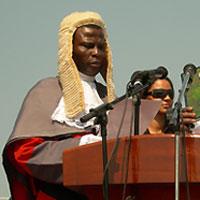
Statement By The Chief Justice Of The Gambia, The Hon Mr Justice Abdou Karim Savage, At The Official Opening Of The2007/2008 Legal Year At The Law Courts Buildings, Banjul On 2nd December 2007
Protocols
Your Excellency
To members of the judicial and legal sector, the legal year celebration is an opportune moment for stock taking, celebrations and reflection on the activities of the period under review.
The sector has the constitutional responsibility to administer and deliver justice, and provide judicial and legal services across the length and breadth of the country. Our contribution to the maintenance of the rule of law, social cohesion and stability is indeed very significant. We playa crucial role in the creation of a conducive climate and environment to attract foreign investments, to facilitate private sector led growth and to reduce poverty.
Practical steps have been taken since the last legal year celebration almost four years ago to advance the judiciary with the objective of enhancing the judicial and legal system with a view to expediting court cases. Among these are:
1. The High Court was divided into Specific Divisions - Commercial, Criminal, Civil and Land, Miscellaneous and Family, Brikama and Basse, introducing specificity in litigation thereby enhancing case management and expediting court proceedings
2. The first Children’s Court and the first in the entire sub region was set up in the Kanifing Municipality devoted to matters concerning and affecting children and young persons.
3. Cadi Appeals Panel was reconstituted and is headed by a Gambian sharia law expert providing access to dis-satisfied litigants of the Cadi Courts.
4. Rules for Cadi Courts and Cadi Appeal Panel have been drafted and will be reviewed and validated by Stakeholders in the coming weeks
5. A Drugs Court was also established at Brikama focusing on drug related offences only.
6. The Basse High Court has been enlivened with two criminal sessions this year bringing justice closer to people. Government has provided funding to refurbish and furnish the Court and a Judge has been assigned to cover Basse jurisdiction on a permanent basis. The permanent running of that court will decongest the High Court, provide access to justice to people within those areas thereby reducing costs and time in litigation and expediting court cases.
7. A court annexed ADR system was set up as an alternative form of dispute resolution still within the court system
8. A Computer Aided Transcription System is on pilot in one High Court. The electronic system records, transcribes and produces transcripts of proceedings within hours of a hearing. Reviewed by stakeholders recently, the system will reduce incidence of lost records, delays in processing cases and appeals as well as considerably expedite matters and ensure security and access.
9. A Financial Management system is in place facilitating the internal management of our payroll and accounting system
10. Members of the Judicial Service Commission reviewed draft Regulations for the Commission for introduction pursuant to the Constitution during the coming year.
11. Judiciary Staff Rules have been drafted and will be reviewed subject to an enabling legislation. Financial Regulations to support the self accounting status have also been drafted.
12. As part of our capacity building efforts in subordinate courts, four magistrates have recently proceeded on various professional courses abroad. All other magistrates have been attending regular monthly training sessions aimed at strengthening the capacity of the lower bench as well as preparing them for higher duties.
13. Capacity building: over twenty-five local training and sensitization workshops, more than ten overseas training programmes and eight major consultancies have been undertaken over the period These activities reached a large number and variety of personnel and stakeholders including, Chief Justice, Judges of Superior Courts, Magistrates, various management, registry and enforcement staff, members of specific tribunals and personnel from district tribunals. A wide variety of pressing issues have been covered. A great number of more practical topics such as the backlog, improving case record retrieval, drafting a code of ethics for the bench and the bar, revising the records and registry manuals were addressed.
14. A human resource management study has been concluded as well as a legal drafting consultancy resulting in a proposed Judges Bill and a Judicial Service Bill which, if enacted, will serve as good basis for the judicial autonomy contemplated under the Constitution.
Your Excellency,
At the State Opening of the National Assembly this year, Your Excellency outlined Government’s indigenization policy. I am happy to note that Government is moving towards its realization by appointing three Gambians as High Court Judges.
Your Excellency,
The cumulative effect of the development activities outlined here does positively impact in the judiciary and its performance. We will continue to consolidate these gains through renewed commitment, dedication and hard work.
We owe deep gratitude to all those who contributed in making our efforts realizable. Among them,
1. His Excellency, the President and the entire Gambian Cabinet, particularly the Secretaries of State for Justice and Finance and Economic Affairs respectively.
2. We commend the Department for International Development (DflD), UK who will continue to support the legal sector during the next three years under the Legal Capacity Building Programme (LCBP).
3. We also acknowledge the World Bank under the Capacity Building for Economic Management Project (CBEMP)
4. We are grateful to the UNDP under its National Governance Programme
5. Finally, we thank UNICEF and the Commonwealth Secretariat in London
I want to acknowledge the tireless and relentless efforts of the Acting Judicial Secretary who contributed immensely in the achievements of the activities outlined here. I want to thank him and his staff for an making the occasion a great success. I use the opportunity to thank the Hon Judges, Magistrates, Cadis and all judicial officers for their co-operation during our tenure. I am also very grateful to the President and Members of the Bar for’ their collaboration over the years and for turning up in full force to welcome His Excellency the President.
I cannot end this speech without acknowledging the efforts of all in the judiciary: drivers, cleaners, clerks, process servers, bailiffs, interpreters, court reporters, secretaries, accountants, registrars, police guards and all the other support personnel who have continued to support the work of courts and the sector with commitment and dedication.
On that note, I thank you all for your very kind attention.
 See Also - See Also